Energy Auditing
October 28, 2026
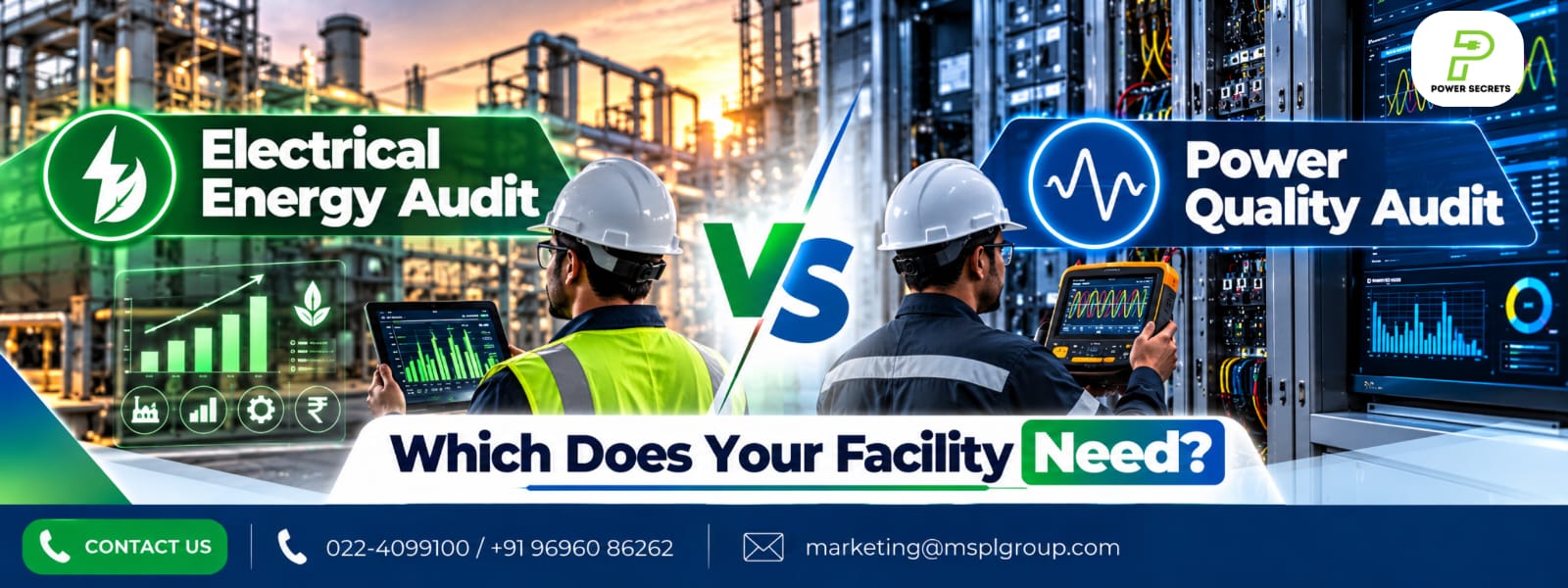
Electrical Energy Audit vs Power Quality Audit: Key Differences
Discover the key differences between an Electrical Energy Audit and a Power Quality Audit to determine which your facility needs. Learn how PowerSecrets helps businesses identify energy wastage, reduce electricity costs, detect power disturbances, improve equipment reliability, and achieve better electrical efficiency through the right audit strategy.
Introduction:
1.Why Choosing the Right Electrical Audit Matters
Electricity is one of the most important operating expenses for manufacturing plants, commercial buildings, hospitals, warehouses, data centers, and other energy-intensive facilities. However, high electricity bills are not always caused by excessive energy consumption alone. Inefficient equipment, poor power factor, harmonic distortion, voltage fluctuations, unbalanced loads, and electrical distribution problems can also affect operating costs and equipment reliability.
This is where an electrical energy audit and a power quality audit become valuable. Although both examine your electrical infrastructure, they address different challenges.
An electrical energy audit evaluates how efficiently a facility uses electricity and identifies opportunities to reduce consumption, improve energy performance, and lower utility costs. A power quality audit investigates whether the electricity supplied to and distributed throughout the facility meets the requirements of sensitive equipment and electrical systems.
For example, a manufacturing facility experiencing unusually high electricity bills may benefit from an energy audit. However, if its production machines repeatedly trip because of voltage disturbances or harmonic distortion, a power quality audit may be more appropriate.
PowerSecrets helps businesses understand electrical performance, identify potential inefficiencies, and make informed decisions about energy management and power reliability. The right audit depends on your facility's symptoms, operating conditions, equipment, and business objectives.
In this guide, we explain the difference between electrical energy audits and power quality audits, their benefits, industry applications, costs and potential return on investment (ROI), and how to determine which audit your facility needs.
2. What Is an Electrical Energy Audit?
An electrical energy audit is a systematic assessment of how electricity is consumed across a facility. Its primary objective is to identify energy wastage, improve efficiency, and reduce electricity expenditure without compromising productivity, safety, or operational performance.
During an electrical energy audit, an auditor examines electricity bills, equipment ratings, operating schedules, load patterns, and energy-consuming systems. Depending on the facility's requirements, the assessment may include measurements of power consumption, demand, power factor, and the performance of major electrical equipment.
Key activities in an electrical energy audit
Reviewing electricity bills and historical consumption.
Identifying high-energy-consuming machinery and equipment.
Measuring electrical loads and operating patterns.
Evaluating motors, pumps, compressors, HVAC systems, and lighting.
Assessing maximum demand and load management opportunities.
Identifying avoidable energy losses and inefficient operating practices.
Recommending energy-saving measures with estimated financial benefits.
Example: A manufacturing plant in Vapi discovers that its compressors operate at unnecessarily high pressure and several motors run during production breaks. An energy audit can identify these inefficiencies and recommend operational changes, controls, or equipment upgrades to reduce electricity consumption.
The exact audit scope depends on the facility, available instrumentation, and applicable energy-audit requirements.
3. What Is a Power Quality Audit?
A power quality audit evaluates the condition of electrical power within a facility and determines whether disturbances could affect equipment performance, production reliability, or electrical infrastructure.
Modern facilities use variable-frequency drives (VFDs), programmable logic controllers (PLCs), server racks, automated production lines, UPS systems, and other sensitive electronic equipment. These systems can be affected by voltage sags, voltage swells, harmonics, transients, frequency variations, and phase imbalance.
A power quality audit uses suitable electrical measurement instruments, such as power quality analyzers and data loggers, to investigate these conditions over an appropriate monitoring period.
Key activities in a power quality audit
Measuring voltage and current variations.
Assessing voltage and current harmonic distortion.
Checking phase imbalance and neutral loading where relevant.
Investigating voltage sags, swells, and transient events.
Evaluating power factor and reactive power.
Monitoring electrical loads during normal and peak operations.
Investigating nuisance tripping, equipment resets, and unexplained shutdowns.
Recommending corrective measures based on measured evidence.
Example: A pharmaceutical production facility experiences repeated PLC resets even though its electricity bills appear normal. A power quality audit may identify recurring voltage disturbances or harmonic-related issues that require further investigation and corrective action.
A power quality audit does not automatically identify every root cause. Findings must be interpreted alongside equipment specifications, event records, electrical system design, and operating conditions.
4. Electrical Energy Audit vs Power Quality Audit: Key Differences
The main difference is the question each audit answers: Are we using electricity efficiently? versus Is our electrical power suitable and reliable for our equipment?
Both audits may measure overlapping parameters, including current, voltage, power factor, and demand. The difference lies in the depth of measurement, monitoring duration, analysis, and the business problem being investigated.
5. When Does Your Facility Need an Electrical Energy Audit?
An electrical energy audit is a strong starting point when your main objective is to control electricity expenses or improve energy efficiency.
Consider an energy audit if:
Your electricity bills are increasing despite similar production levels.
Your plant's energy consumption per unit of output is high.
Your motors, pumps, chillers, or compressors operate inefficiently.
Your maximum demand charges are consistently high.
Your facility operates equipment outside productive hours.
You are planning an expansion or major equipment upgrade.
You need to establish an energy-saving baseline for management.
You want to evaluate potential savings from automation or energy-efficient equipment.
For instance, a warehouse may have excessive lighting consumption, inefficient cooling, and poorly scheduled material-handling equipment. An energy audit can prioritize improvements according to expected energy savings, implementation costs, and operational requirements.
Business takeaway: If your biggest concern is how much electricity your facility consumes and what it costs, start by evaluating the scope of an electrical energy audit.
6. When Does Your Facility Need a Power Quality Audit?
A power quality audit is particularly relevant when electrical disturbances appear to be affecting production, sensitive electronics, or equipment reliability.
Warning signs include:
Frequent PLC, CNC machine, or automation-system resets.
Repeated UPS alarms or unexpected transfers to battery.
Servers restarting without an obvious cause.
Transformers, cables, or neutral conductors experiencing unexplained heating.
Capacitor bank failures or repeated capacitor switching problems.
VFDs tripping despite apparently normal operating conditions.
Flickering lights or noticeable voltage variations.
Equipment malfunctions that occur intermittently and are difficult to reproduce.
These symptoms do not necessarily prove a power quality problem. Faulty equipment, loose connections, incorrect protection settings, inadequate cooling, or software issues may produce similar symptoms.
A properly scoped audit helps establish whether power disturbances are present, when they occur, and which parts of the electrical system may be affected.
7. Electrical Energy Audit vs Power Quality Audit for Different Industries
The most suitable audit depends on how your facility consumes electricity and how sensitive its operations are to electrical disturbances.
For critical facilities, an integrated assessment may provide more value than treating energy efficiency and power reliability as unrelated concerns.
8. Understanding the Main Electrical Parameters
Understanding a few key parameters helps facility managers choose the right audit scope.
Energy consumption (kWh)
Kilowatt-hours measure the amount of electrical energy consumed over time. Energy audits use this information to establish baselines and identify savings opportunities.
Maximum demand (kW or kVA)
Maximum demand represents the highest measured demand over the applicable billing interval. The precise billing method depends on the electricity tariff and utility rules. Managing demand can reduce costs where the tariff rewards or penalizes peak demand.
Power factor
Power factor describes how effectively electrical power is converted into useful work, considering the relationship between active and apparent power. A poor power factor may increase current and attract additional charges under certain tariffs.
Harmonic distortion
Harmonics are waveform components at frequencies that are integer multiples of the fundamental frequency. Excessive harmonic distortion can contribute to heating, equipment malfunction, and other electrical problems.
Voltage sag and swell
A voltage sag is a temporary reduction in RMS voltage; a swell is a temporary increase. Both can affect sensitive equipment, depending on their magnitude, duration, and the equipment's tolerance.
These parameters overlap across audit types. Their importance depends on whether the goal is energy savings, equipment reliability, or both.
9. How Is an Electrical Energy Audit Conducted?
A structured energy audit typically follows a series of steps to ensure that recommendations are practical, measurable, and financially justified.
Review energy records: Examine electricity bills, tariff structures, historical consumption, and demand data.
Inspect the facility: Identify major loads, equipment operating schedules, and possible sources of energy waste.
Measure consumption: Use appropriate meters and instruments to assess significant loads under representative operating conditions.
Establish a baseline: Compare energy consumption with production output, occupied area, operating hours, or another relevant indicator.
Identify opportunities: Evaluate equipment efficiency, control settings, maintenance practices, and operational improvements.
Calculate savings: Estimate potential energy reductions, investment costs, and payback periods.
Prepare an action plan: Rank recommendations by cost, expected savings, implementation complexity, and business impact.
Verify results: Compare actual performance with the baseline after implementing approved measures.
For example, a facility that reduces compressed-air leakage and optimizes motor operating schedules may lower energy consumption without replacing its entire electrical infrastructure.
10. How Is a Power Quality Audit Conducted?
Power quality investigations require measurements that capture electrical behavior over time. A brief inspection may not reveal intermittent events, so monitoring duration should reflect the symptoms and operating conditions.
A typical assessment involves:
Define the problem: Document equipment trips, shutdown times, alarms, and affected production processes.
Inspect the electrical system: Review distribution panels, earthing arrangements, protective devices, UPS systems, and connected equipment as appropriate.
Select monitoring points: Choose locations that help distinguish supply-side disturbances from problems within the facility.
Record electrical data: Use suitable instruments to capture voltage, current, harmonics, and relevant event data.
Correlate events: Compare recorded disturbances with equipment alarms and production logs.
Identify probable causes: Assess whether the issue relates to incoming supply, internal loads, switching events, wiring, or equipment behavior.
Recommend corrective action: Consider load balancing, harmonic mitigation, suitable power conditioning, equipment maintenance, or protection coordination.
Verify improvements: Repeat measurements where appropriate to establish whether the corrective action achieved the intended result.
Monitoring duration can range from a targeted investigation to several days or longer, depending on the frequency of disturbances and the nature of the problem.
11. Can Your Facility Benefit From Both Audits?
Yes. An integrated electrical energy and power quality audit can be particularly useful for facilities where high electricity costs and operational interruptions occur together.
Consider a manufacturing plant that operates large motors, VFDs, automated assembly lines, and a central UPS system. An energy audit may identify inefficient motors and unnecessary peak demand. A power quality audit may reveal harmonic distortion or voltage disturbances affecting sensitive control equipment.
The combined findings help management distinguish between energy-saving measures and reliability improvements while understanding how they interact.
However, the two assessments should have clearly defined objectives. An energy audit that does not include sufficiently detailed disturbance monitoring should not be assumed to have ruled out power quality problems. Similarly, a short power quality investigation may not be sufficient to identify all energy-saving opportunities.
Recommended approach: If your facility has both rising electricity costs and unexplained downtime, discuss a combined audit scope with a qualified electrical or energy professional.
12. Electrical Energy Audit and Power Quality Audit: Tools and Measurements
The tools used depend on the required level of investigation, the installation, and the relevant standards.
Not every instrument measures every parameter. For example, a basic clamp meter cannot replace a power quality analyzer for capturing short-duration voltage disturbances or detailed harmonic data.
Thermal imaging can identify temperature anomalies, but it does not independently establish whether the cause is poor power quality, overloading, a loose connection, or another issue.
13. ROI and Financial Benefits of Electrical Audits
The financial return from an audit depends on the problems identified, the cost of corrective action, operating hours, electricity tariffs, and the degree to which recommendations are implemented.
Example: Electrical energy audit ROI
Suppose a facility has an annual electricity bill of ₹60 lakh and identifies measures expected to reduce eligible electricity costs by 8%.
Annual electricity cost: ₹60,00,000
Assumed savings: 8%
Estimated annual savings: ₹4,80,000
Illustrative audit and implementation investment: ₹2,40,000
Simple payback:
Paybackperiod=₹2,40,000₹4,80,000=0.5years
This equals approximately six months.
The figures are illustrative, not a guarantee of savings. Actual results depend on verified opportunities and implementation performance.
Example: Power quality audit ROI
Suppose a facility estimates that electrical disturbances contribute to ₹8 lakh in annual production losses. After investigation, it implements corrective measures costing ₹3 lakh and estimates that the measures could prevent 50% of those losses.
Estimated annual avoided losses: ₹4,00,000
Corrective investment: ₹3,00,000
Simple payback: 9 months
This example assumes that the identified disturbances are responsible for the relevant losses and that the corrective measures achieve the projected reduction. Both assumptions should be validated before investment decisions are made.
Financial benefits beyond direct savings
An electrical audit may also help a business:
Reduce avoidable operating expenditure.
Improve equipment utilization.
Prioritize maintenance investments.
Support capital budgeting and expansion planning.
Reduce the likelihood of production disruption.
Improve energy performance reporting.
For financial evaluation, distinguish measured savings from projected savings and direct cost reductions from estimated avoided losses.
14. Common Mistakes When Choosing an Electrical Audit
Businesses sometimes select an audit based only on the lowest quotation or assume that one assessment will resolve every electrical problem.
Avoid these common mistakes:
Focusing only on electricity bills: Lower consumption does not necessarily mean better power quality.
Assuming normal bills mean healthy electrical power: Intermittent disturbances can occur even when energy costs remain stable.
Ignoring equipment complaints: Repeated resets and trips deserve investigation even when they appear occasional.
Using unsuitable instruments: Basic measurements may miss short-duration events or detailed harmonic problems.
Accepting recommendations without measurements: Corrective investments should be supported by evidence wherever practical.
Ignoring implementation costs: Energy savings and reliability benefits must be evaluated against the cost of corrective action.
Skipping verification: Post-implementation checks help establish whether the recommendations worked.
Treating power factor as the only power quality indicator: Harmonics, voltage disturbances, imbalance, and other conditions may also matter.
The most effective audit begins with a clearly defined business problem, an appropriate technical scope, and measurable objectives.
15. Electrical Audit Standards and Compliance in India
Electrical energy audits and power quality assessments should follow applicable requirements and relevant technical standards.
In India, the Bureau of Energy Efficiency (BEE) provides the framework for energy efficiency and energy auditing. Certain designated consumers may be subject to specific energy audit, reporting, or energy management obligations under applicable regulations. Requirements depend on the facility, industry, and current rules.
Power quality assessments may refer to applicable Indian Standards, relevant IEC standards, utility requirements, and equipment manufacturers' specifications. The appropriate criteria depend on the parameter being measured and the type of installation.
Before commissioning an audit, businesses should confirm:
Whether any statutory energy audit obligations apply.
Whether the selected auditor has the required qualifications for the assignment.
Which technical standards and measurement methods are relevant.
Whether the audit report includes measurement conditions and limitations.
Whether recommendations address electrical safety and equipment requirements.
An audit should not be presented as a certification of compliance unless the required assessment and certification process has actually been completed.
16. How to Choose the Right Electrical Audit Service Provider
Selecting a capable service provider is essential for obtaining useful, actionable results.
Look for a provider that:
Understands your industry's electrical systems and operating conditions.
Defines the audit scope before starting work.
Uses suitable, properly maintained measuring instruments.
Explains the measurement methodology and limitations.
Provides clear findings supported by recorded data.
Prioritizes recommendations by cost, risk, and expected benefits.
Offers practical guidance for implementation and verification.
Considers electrical safety, equipment specifications, and applicable standards.
Ask whether the provider will deliver a written report, estimated savings or avoided-loss calculations, a prioritized action plan, and recommendations for follow-up measurements.
A good audit report should help decision-makers understand not only what is wrong, but also why it matters, how it can be addressed, and what evidence will demonstrate improvement.
17.Why Choose PowerSecrets for Electrical Energy Audit and Power Quality Assessment?
For industrial and commercial facilities, understanding electrical performance is the first step toward improving efficiency, controlling operating costs, and protecting critical equipment.
PowerSecrets focuses on energy management and electrical performance topics that help businesses identify opportunities for improvement and make informed infrastructure decisions.
Whether your facility is experiencing high electricity bills, inefficient equipment operation, unexplained electrical trips, or concerns about power reliability, selecting the right assessment is essential.
A well-planned audit can help you:
Understand your facility's electrical consumption and operating patterns.
Identify potential energy-saving opportunities.
Investigate power quality concerns using appropriate measurements.
Prioritize corrective actions according to operational needs.
Evaluate the financial impact of recommended improvements.
Develop a practical plan for ongoing energy management.
Planning an electrical audit for your facility? Contact PowerSecrets to discuss your requirements and determine whether an electrical energy audit, power quality assessment, or combined approach is appropriate for your business.
Call to action: Request an Electrical Audit Consultation.
FAQs
Q1. What is the difference between an electrical energy audit and a power quality audit?
An electrical energy audit focuses on how efficiently a facility consumes electricity and identifies opportunities to reduce energy costs. A power quality audit examines voltage and current disturbances, harmonics, and other electrical conditions that may affect equipment performance and reliability.
Q2. Which audit should I choose if my electricity bills are high?
An electrical energy audit is generally the best starting point when your main concern is high electricity consumption, rising operating costs, or inefficient equipment. Reviewing tariffs, maximum demand, and power factor may also be important, depending on your electricity bill.
Q3. Which audit is suitable for frequent UPS alarms and equipment tripping?
A power quality audit may be appropriate if voltage disturbances, harmonics, or other electrical conditions are suspected. However, UPS faults, battery degradation, overloaded circuits, incorrect settings, and equipment failures should also be investigated.
Q4. Can an electrical energy audit identify power quality problems?
An energy audit may identify certain electrical issues, particularly if the scope includes relevant measurements. However, detailed power quality problems may require dedicated monitoring equipment, suitable measurement intervals, and a separate investigation.
Q5. How long does a power quality audit take?
The duration depends on the facility's size, the number of monitoring points, the type of equipment, and how frequently disturbances occur. Some investigations can be completed quickly, while intermittent problems may require several days or longer of monitoring.
Q6. How much does an electrical energy audit cost in India?
The cost varies according to facility size, audit depth, instrumentation, site conditions, and reporting requirements. Businesses should obtain a scope-based quotation rather than rely on a single standard price.
Q7. Can power quality problems increase electricity costs?
Yes. Depending on the circumstances, harmonic distortion, poor power factor, electrical losses, and inefficient equipment operation may contribute to higher costs. However, the financial impact should be established through measurements and tariff analysis rather than assumed.
Q8. Is a power quality audit necessary for data centers?
It can be valuable for data centers because servers, UPS systems, cooling equipment, and power distribution infrastructure require reliable electrical performance. The audit scope should consider critical loads, UPS operating conditions, harmonic behavior, and relevant equipment requirements.
Q9. Are electrical energy audits mandatory in India?
Some designated consumers and facilities may have statutory energy audit or reporting obligations under applicable Indian regulations. Requirements vary by category and current rules, so businesses should verify their specific obligations with the relevant authorities or a qualified professional.
Q10. Can both audits be performed together?
Yes. A combined assessment can help facilities investigate energy inefficiencies and electrical disturbances in one coordinated exercise. The scope should clearly identify the measurements, deliverables, and objectives for each audit.
Conclusion: Make the Right Audit Decision for Your Facility
Choosing between an electrical energy audit and a power quality audit starts with understanding your facility's biggest challenge.
If your primary concern is rising electricity expenditure, inefficient machinery, excessive demand, or energy wastage, an electrical energy audit can help identify savings opportunities and improve energy performance.
If your facility experiences repeated equipment trips, voltage fluctuations, harmonic distortion, unexplained shutdowns, or problems affecting sensitive electronic systems, a power quality audit can help investigate the underlying electrical conditions.
For facilities facing both high energy costs and reliability concerns, a combined audit may offer a more complete understanding of electrical performance.
The objective is not simply to conduct an audit. It is to use reliable measurements, practical recommendations, and financial analysis to improve operational efficiency and make better investment decisions.
Take the next step with PowerSecrets. Assess your facility's energy performance, investigate electrical issues, and build an informed strategy for reducing avoidable costs and improving power reliability.