Energy Auditing
August 31, 2026
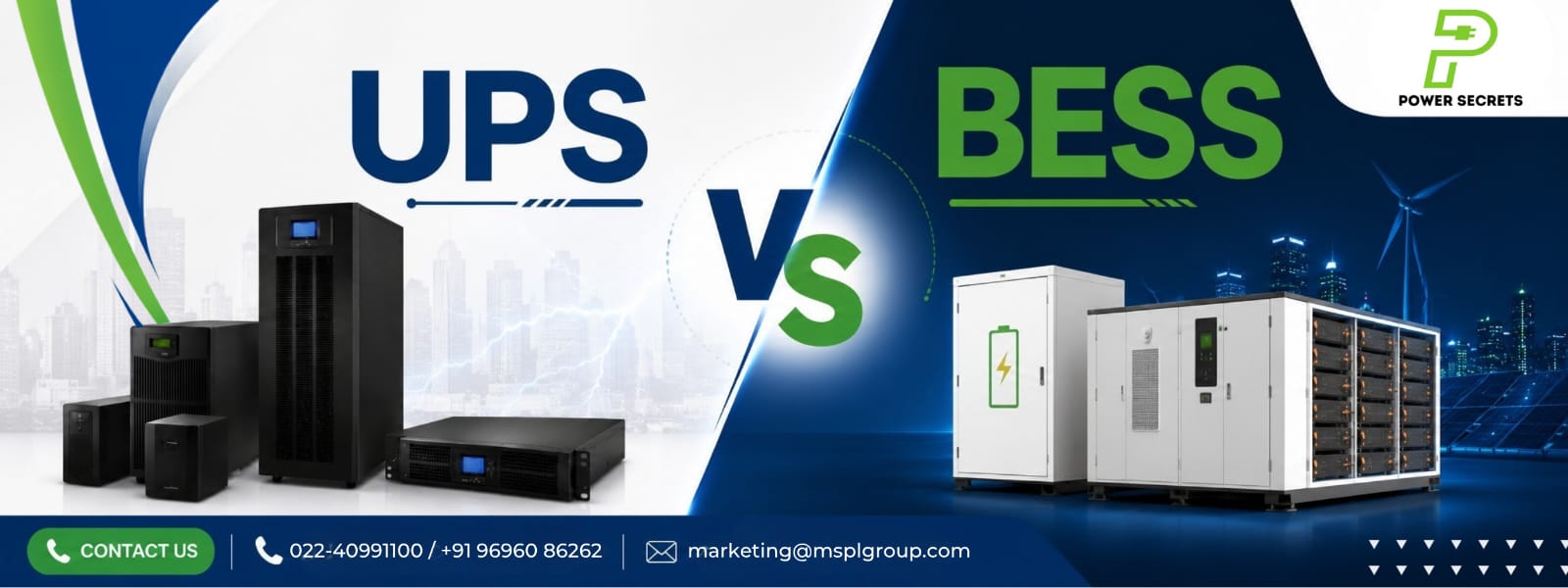
UPS vs BESS: Which Backup Solution Is Right for You?
A simple guide comparing UPS and Battery Energy Storage Systems (BESS), including their key features, benefits, costs, and ideal applications to help you choose the right backup power solution.
UPS vs BESS: A Practical Guide to Choosing Backup Power
Choosing between a UPS (Uninterruptible Power Supply) and a BESS (Battery Energy Storage System) is not simply a choice between two battery technologies. The right solution depends on the criticality of the load, required response time, backup duration, power quality, operating profile, available space, safety requirements and long-term economics. UPS systems are primarily designed to protect sensitive equipment from power interruptions and disturbances, while BESS can store larger amounts of energy and support broader energy-management applications.
For data centers, hospitals, manufacturing plants, telecom sites and commercial buildings, a well-designed backup strategy often uses one technology—or a combination of both—to match different electrical loads. This guide explains the differences between UPS and BESS, where each performs best, how to evaluate ROI, and what questions decision-makers should ask before investing.
What Is a UPS and How Does It Work?
A UPS system provides immediate backup power when the utility supply fails or moves outside acceptable limits. Depending on the design, a UPS can also regulate voltage, filter disturbances and provide a stable electrical output to sensitive loads. Online double-conversion UPS systems are widely used for critical infrastructure because the load is continuously supplied through the power-conversion stage.
UPS systems are generally selected around the critical load in kVA/kW and the required battery runtime. Their primary objective is continuity and power quality rather than long-duration energy storage.
What Is BESS and How Does Battery Energy Storage Work?
A Battery Energy Storage System (BESS) combines batteries with power-conversion equipment, controls, monitoring and safety systems to store electrical energy and deliver it when required. Lithium-ion batteries are common in modern BESS installations, although battery chemistry should be selected according to application, safety, lifecycle and project requirements.
BESS can provide backup power, peak shaving, load shifting, renewable-energy integration and other energy-management functions. This makes BESS particularly attractive where the facility needs more than emergency backup.
UPS vs BESS: Key Differences at a Glance
UPS vs BESS for Data Centers
Data centers require exceptionally high availability and stable power for servers, networking equipment, storage and cooling systems. A UPS is normally the first layer for critical IT loads because it is purpose-built for continuity and power conditioning.
BESS can complement a UPS where longer backup duration, generator optimization, renewable integration or peak-demand management is important. For an AI data center, where high-density racks can create substantial power demand, engineers may evaluate a layered architecture combining UPS protection for critical loads with larger-scale energy storage for resilience and energy management.
Need help planning backup power for a data center? Contact our power-backup specialists for a load, runtime and battery assessment.
UPS vs BESS for Manufacturing Plants
Manufacturing facilities may have a mix of sensitive automation controls and large electrical loads. A UPS can protect PLCs, industrial controls, networking equipment and critical instrumentation from short interruptions. BESS may be more suitable when the plant also needs peak shaving, demand management or longer-duration support.
The best approach is often to separate truly critical loads from non-critical loads instead of trying to size one system for the entire plant.
UPS vs BESS for Hospitals and Healthcare Facilities
Hospitals need reliable electricity for life-support equipment, monitoring, diagnostics, communications and critical building systems. UPS systems can provide immediate continuity to sensitive loads while standby generation and, where appropriate, BESS can address longer outages and energy-management needs.
Healthcare projects should be engineered around applicable electrical, fire-safety and healthcare requirements rather than selecting equipment solely on battery capacity or price.
UPS vs BESS for Telecom and Network Infrastructure
Telecom sites and network facilities often need dependable backup with controlled battery maintenance and remote monitoring. UPS systems are useful for equipment requiring conditioned, uninterrupted power, while BESS can be considered when longer autonomy or broader energy-management capabilities justify the additional system architecture.
Remote sites can particularly benefit from monitoring, battery-health analytics and carefully planned maintenance schedules.
UPS vs BESS for Commercial Buildings
Commercial buildings may need backup for IT rooms, security systems, elevators, building controls and other selected loads. A UPS is generally appropriate for sensitive electronic loads requiring seamless continuity. BESS can add value where the building has substantial peak demand, solar generation or a need to manage energy consumption over time.
Instead of asking only “UPS or BESS?”, facility managers should ask which loads require uninterrupted power and which loads need longer-duration energy support.
UPS Battery Technologies: VRLA vs Lithium-Ion
UPS batteries can use technologies such as VRLA (Valve Regulated Lead Acid) or lithium-ion. VRLA remains widely used because of its established supply chain and familiar maintenance practices. Lithium-ion can offer higher energy density, longer useful life in suitable operating conditions and reduced footprint, but its economics and safety requirements must be evaluated for the application.
For both UPS and BESS projects, battery selection should consider temperature, cycling profile, depth of discharge, expected life, monitoring, replacement strategy and total cost of ownership—not simply the initial purchase price.
BESS Battery Chemistry and Safety Considerations
BESS design involves more than choosing a battery chemistry. The complete system can include battery-management systems, power-conversion systems, thermal management, fire detection and suppression provisions, controls and enclosure design.
Project teams should evaluate applicable local codes, standards, fire-safety requirements, ventilation or thermal-management needs, installation conditions and emergency procedures. A qualified engineering and installation team is essential for critical-energy-storage projects.
UPS vs BESS: Runtime and Power Capacity
One of the most important distinctions is the relationship between power and energy. UPS capacity is commonly discussed in kVA and kW, while battery storage is also described in kWh or MWh. A system may have sufficient power capability but insufficient stored energy for the required runtime.
For example, a simplified energy estimate is:
Required battery energy ≈ Load power × Backup duration ÷ Overall efficiency
Actual sizing requires allowances for battery characteristics, operating limits, temperature, ageing, conversion losses, redundancy and manufacturer specifications.
UPS vs BESS: Reliability and Power Quality
If the priority is protecting sensitive electronics from voltage disturbances, frequency variation, harmonics and interruptions, a UPS is usually the more direct solution. BESS can provide backup power through its inverter or PCS, but its power-quality performance depends on the complete system architecture.
For mission-critical applications, reliability should be assessed at the system level, including redundancy, bypass arrangements, battery strings or modules, monitoring, controls, maintenance procedures and failure modes.
UPS vs BESS Cost: What Should You Compare?
Comparing only equipment purchase prices can produce the wrong decision. A proper UPS vs BESS cost comparison should include installation, electrical infrastructure, HVAC or thermal management, fire protection, battery replacement, maintenance, monitoring, floor space, energy savings and expected operating life.
UPS vs BESS ROI and Financial Benefits
The ROI of UPS vs BESS depends heavily on how often the system is used and whether it creates value beyond emergency backup. A UPS primarily protects against downtime and power-quality events. The financial benefit can therefore come from avoided production losses, equipment disruption, data loss and business interruption.
BESS may generate additional financial benefits through peak shaving, demand-charge management, time-of-use energy shifting, renewable-energy integration and reduced generator dependence, where these applications are technically and commercially viable.
For a robust business case, calculate total cost of ownership and quantify the cost of one hour of downtime, expected outage frequency, demand charges, energy tariffs, battery degradation and maintenance requirements.
When Should You Choose a UPS?
Choose a UPS when instant power continuity, stable power quality and protection of sensitive critical loads are the main priorities. Typical examples include server rooms, data-center IT loads, medical equipment, control systems, networking equipment and industrial automation.
A UPS is especially compelling when the protected load cannot tolerate even a short interruption and the required battery autonomy is relatively limited.
When Should You Choose a BESS?
Consider a BESS when the project needs larger energy capacity, longer-duration backup or active energy management. BESS can be valuable for facilities combining solar PV, high demand, variable loads, generator coordination or time-based energy consumption.
However, BESS should not automatically replace a UPS for loads that require the specific power-quality and continuity characteristics of a UPS architecture.
Can You Use UPS and BESS Together?
Yes. In many advanced power-backup strategies, UPS and BESS work together rather than competing. A UPS can protect the most critical loads from instantaneous disturbances, while a larger BESS can provide extended energy support and energy-management functions.
This layered approach can improve resilience and allow the facility to size each technology according to its actual role. The architecture should be engineered around load hierarchy, redundancy targets, backup duration, generator strategy and electrical-infrastructure constraints.
Planning a hybrid UPS + BESS system? Talk to our team for a site-specific power and energy assessment.
How to Select the Right Backup Power Solution
Use these questions before selecting equipment:
Which loads are mission-critical?
How many milliseconds of interruption can each load tolerate?
What backup runtime is required?
What are the peak and average loads?
Is power-quality conditioning required?
Are peak-demand or energy-shifting savings available?
Is solar PV part of the energy strategy?
What space, cooling and fire-safety provisions are available?
What redundancy level is required?
What is the five- to fifteen-year total cost of ownership?
The answers usually make the technology choice clearer than comparing product specifications alone.
UPS vs BESS: Decision Matrix
Common UPS vs BESS Mistakes to Avoid
Avoid selecting a system solely on battery capacity, assuming BESS automatically provides UPS-level protection, or comparing only the upfront price. Other common mistakes include ignoring battery ageing, underestimating thermal requirements, failing to separate critical and non-critical loads, and overlooking maintenance and end-of-life planning.
Another mistake is sizing backup around average consumption when the facility has significant peak loads. Proper load measurements and an engineering review can prevent expensive oversizing or inadequate autonomy.
FAQ
Is BESS better than UPS?
Neither is universally better. UPS is generally better for immediate continuity and power-quality protection of critical loads, while BESS is better suited to larger energy storage and energy-management applications.
Can BESS replace a UPS?
A BESS can provide backup power, but whether it can replace a UPS depends on the required response time, power-quality performance, load characteristics, redundancy and system architecture. Critical electronic loads may still require a UPS.
What is the main difference between UPS and BESS?
UPS is primarily designed for uninterrupted power and power-quality protection. BESS is primarily an energy-storage platform that can provide backup plus applications such as peak shaving, load shifting and renewable integration.
Which is better for a data center: UPS or BESS?
For critical IT loads, UPS is typically the direct protection technology. BESS can complement the UPS for longer backup, generator optimization and energy management. The appropriate architecture depends on the data center's load and resilience requirements.
Is BESS more cost-effective than UPS?
It depends on the application. BESS can have stronger economics when it provides multiple value streams beyond backup. UPS can be more economical when the requirement is primarily short-duration protection of a critical load.
What is the ROI of a BESS?
BESS ROI depends on capital cost, tariff structure, demand charges, cycling, degradation, energy savings, backup value and incentives where applicable. A project-specific financial model is more useful than a generic payback period.
Can UPS batteries be used in BESS?
Battery compatibility is application-specific. A battery designed for one UPS or storage architecture should not be assumed suitable for another system without confirming electrical, thermal, control, safety and manufacturer requirements.
Conclusion
The best backup solution is the one that matches the facility's actual power, energy, reliability and financial requirements. UPS remains the natural choice for uninterrupted protection and power quality, while BESS expands the role of batteries into longer-duration storage and active energy management. For complex facilities, a UPS + BESS hybrid strategy can deliver both critical-load protection and broader energy resilience.
Before investing, evaluate load profiles, runtime, redundancy, battery technology, safety, lifecycle cost and measurable financial benefits. A professional site assessment can turn these factors into a practical architecture and investment plan.
Need help choosing between UPS, BESS or a hybrid backup system? Contact our power-backup experts for a site assessment, load analysis and ROI evaluation.